Sunday, June 12, 2011

Solitary Watch Confronts Torture in US Prisons --An interview with James Ridgeway and Jean Casella


Solitary Watch Confronts Torture in US Prisons --An interview with James Ridgeway and Jean Casella

By Angola 3 News

Prisoners in the Security Housing Unit (SHU) at Pelican Bay State Prison in California have announced that they are beginning an indefinite hunger strike on July 1, 2011 to protest the conditions of their imprisonment, which they say are cruel and inhumane. An online petition has been started by supporters of the strikers. While noting that the hunger strike is being “organized by prisoners in an unusual show of racial unity,” five key demands are listed by California Prison Focus:

1) Eliminate group punishments; 2) Abolish the debriefing policy and modify active/inactive gang status criteria; 3) Comply with the recommendations of the US Commission on Safety and Abuse in Prisons (2006) regarding an end to long term solitary confinement; 4) Provide adequate food; 5) Expand and provide constructive programs and privileges for indefinite SHU inmates.

Notably, Pelican Bay is ‘home’ to the only US prisoner known to have spent more time in solitary confinement than the 39 years that Herman Wallace and Albert Woodfox of the Angola 3, have spent--since April 1972. Imprisoned now for a total of 47 years and held at Pelican Bay since 1990, Hugo Pinell has been in continuous solitary for over 40 years, since at least 1971--probably even since the late 1960’s. Pinell was a close comrade of Black Panther leader George Jackson, who had organized a Panther chapter inside California’s San Quentin Prison, similar to the prison chapter organized by the Angola 3 in Louisiana.

Journalist Kiilu Nyasha writes that on Aug. 21, 1971, the day of George Jackson’s assassination, “three prison guards and two inmate trustees were also killed. Subsequently, six prisoners, including Hugo Pinell, were singled out and put on trial. Reminiscent of the slave auctions, they were each forced to bear 30 lb. of chains in a Marin courtroom after being charged with numerous counts of murder and assault.” They became known as the San Quentin Six. Johnny Spain, the only defendant to be convicted of murder, was released in 1988, making Pinell the last of the San Quentin Six behind bars, despite having being convicted of a lesser assault charge (read more).

Robert King, of the Angola 3, released in 2001 after 29 years in solitary, has expressed support for Pinell, saying that he "is a clear example of a political prisoner." In January 2009, Pinell was denied parole for the ninth time, despite a clean record with no-write ups for the past 25 years. Now, in 2011, with 27 years of ‘clean time,’ Pinell is eligible for parole once again, but his hearing has been postponed for six months and is expected later this year.

For decades now, human rights activists have criticized the infamous Pelican Bay supermax prison. Journalists James Ridgeway and Jean Casella, co-founders of the new Solitary Watch website, are similarly critical of conditions at Pelican Bay, and they argue that the treatment of prisoners at Pelican Bay is a reflection of a widespread human rights crisis throughout the US prison system.

Angola 3 News: How did you first become interested in the issue of solitary confinement and ultimately become inspired to start Solitary Watch?

Solitary Watch: We started Solitary Watch because this issue grabbed us by the throats. The solitary confinement of tens of thousands of prisoners may be the most grievous mass human rights violation that’s taking place on American soil, yet it’s been largely concealed from and ignored by the public, and seriously under-reported by the press.

Solitary confinement is a hidden world within the larger hidden world of the prison system, and prisoners in solitary are an invisible and dehumanized minority within the larger population of prison inmates in general--who also remain remarkably invisible and dehumanized, considering that they now number nearly 2.3 million and constitute one in every 100 adults in this country.

We don’t mean to sound self-righteous about any of this, because until two years ago we were as ignorant about this subject as anyone. Like so many other people, we were outraged by the abuses taking place at Guantanamo or Abu Ghraib, yet we knew relatively little about the abuses happening here at home, in our own prisons and jails. What changed that was Jim’s reporting for Mother Jones on the Angola 3. To discover that there were men who had been living isolated in 6 x 9-foot cells for nearly 40 years—well, that clearly shocked the conscience.

That was the beginning of our education. We began to learn more and more about this torturous netherworld of solitary confinement that exists, in one form or another, in every state of the union. And we discovered that there were activists and lawyers and scholars and prisoners’ families and even a handful of journalists out there who were trying to draw attention to the issue, but no centralized, comprehensive source of information.

A3N: Can you please briefly tell us about your background before Solitary Watch?

SW: Jim has more than 40 years of experience as an investigative journalist, and Jean has been an editor for independent media and run small nonprofit organizations. It seemed like together we had the skills we needed to start up a web-based project that would serve as an information clearinghouse on solitary confinement, as well as a forum for whatever original reporting we might do on the subject. And we’ve been fortunate enough to get some funding from several generous donors. That was the genesis of Solitary Watch, which went online a year and a half ago.

A3N: What is a SHU?

SW: SHU is just one of many euphemisms prison systems have developed to avoid using the term “solitary confinement.” In California, it stands for Security Housing Unit; in New York it is Special Housing Unit. Elsewhere we see Special Management Units, Behavioral Management Units, Communications Management Units, Administrative Segregation, Disciplinary Segregation—the list goes on. There are nuances of difference among them, but they all consist of 23- to 24-hour-a-day lockdown. Most of these systems—including the federal Bureau of Prisons—deny that they use solitary confinement, even while they have tens of thousands of prisoners locked alone in their cells for months, years, even decades.

A3N: When was the first SHU made?

SW: Solitary confinement was actually invented here in the United States, in the early 19th century in Philadelphia, as a supposedly humane alternative to things like floggings and hard labor. Prisoners were locked up alone, with absolutely nothing to do but contemplate their crimes, pray, and supposedly become “penitent”—thus the term “penitentiary.” Of course, nothing like that happened. The U.S. Supreme Court looked at conditions in the Philadelphia prison in 1890 and found that "A considerable number of the prisoners fell, after even a short confinement, into a semi-fatuous condition, from which it was next to impossible to arouse them, and others became violently insane; others still, committed suicide; while those who stood the ordeal better were not generally reformed, and in most cases did not recover sufficient mental activity to be of any subsequent service to the community."

For nearly 100 years after that, solitary confinement was rare; the famous Birdman of Alcatraz spent six years in solitary, and that was unusual. Things really began to change in 1983, when two guards at the federal prison in Marion, Illinois, were killed by inmates on the same day. That was the beginning of the notorious Marion Lockdown, where prisoners were permanently confined to their cells without yard time, work, or any kind of rehabilitative programming.

A3N: How have they developed since?

SW: Other prisons followed suit, and in 1989 California built the first supermax—Pelican Bay. There was a supermax boom in the 1990s, and today, 40 states and the federal government have supermax prisons holding upwards of 25,000 inmates. Tens of thousands more are held in solitary confinement in lockdown units within other prisons and jails. There’s no up-to-date nationwide count, but according to best estimates, there are at least 75,000 and perhaps more than 100,000 prisoners in solitary confinement on any given day in America.

Solitary confinement has become the disciplinary measure of first resort, rather than of last resort. Today you can be placed in solitary confinement not only for violence, but for any form of “insubordination” toward prison officials. Others are put there for having contraband—which includes not only drugs but cell phones or even too many postage stamps. Still others—including many of the juveniles in adult prisons--end up in solitary for their own “protection” because they are targets of prison rape. A lot of the men in Pelican Bay’s SHU are there because they’ve been “validated” as gang members, based on the say-so of inmate “snitches” who are rewarded for informing. The reasons are countless, and sometimes absurd. In Virginia, a group of Rastafarian men was in solitary for a decade because they refused to cut their dreadlocks, in violation of prison rules.

A3N: What are effects of the SHU on prisoners’ health and well-being?

SW: As one prisoner at the Tamms supermax in Illinois said, "Lock yourself in your bathroom for the next 10 years and tell me how it will affect your mind."

If it weren’t already obvious enough, research conducted over the last 30 years confirms solitary confinement has an extremely damaging effect on mental health. One study found that a single week in solitary produced a change in EEG activity related to stress and anxiety. There’s evidence that long-term isolation profoundly alters the brain chemistry, and that longer stretches in solitary produce psychopathologies—including panic attacks, depression, inability to concentrate, memory loss, aggression self-mutilation, and various forms of psychosis--at a considerably higher rate than other forms of confinement. Yet we have prison systems that insist they are placing prisoners in solitary so that they can “learn self-control,” and many cases where inmates are released directly from long-term isolation onto the streets. Unsurprisingly, they have a notably higher recidivism rate than other prisoners.

It’s important to acknowledge, also, that a huge number of prisoners who are placed in solitary suffer from underlying mental illness. After 40 years of cuts to funding for mental health care, prisons and jails in general—and solitary confinement cells in particular--have become America’s new asylums. Prisoners are placed in solitary for being disruptive, when what they are doing is simply exhibiting the untreated symptoms of mental illness. One report by Human Rights Watch found that in prison systems around the country, one-third to one-half of the prisoners held in solitary were mentally ill. Other studies have found that two-thirds of all prison suicides take place in solitary confinement.

There has been less research done on the physical effects of solitary confinement, but evidence from recent court cases suggests a relationship to things like extreme insomnia, joint pain, hypertension and even damage to the eyesight—which makes sense when you are talking about not being able to walk or look more than ten feet in any direction for years or decades on end. We will clearly see more evidence of health damage as more and more prisoners grow old in long-term solitary confinement.

A3N: The hunger strike at Pelican Bay will begin on July 1, and the strikers have made five demands. Do you think these policies being protested are violations of international human rights standards? Of domestic US laws?

SW: First, we want to say what a remarkable document this is, remembering that it was written by a group of men who are largely unable to communicate with one another or with the outside world, and who have limited access to research materials. It’s a tribute to their perseverance and dedication to their cause, as well as their courage.

Second, we should emphasize how measured and reasonable their set of demands is. It draws heavily on the findings of the Commission on Safety and Abuse in America’s Prisons, which was a bipartisan, blue-ribbon commission that studied U.S. prisons and jails. As one of its three major findings on prison conditions, the Commission said that the growing use of “high-security segregation” was counterproductive and often cruel. The Pelican Bay hunger strikers have adopted the recommendations of the Commission for reforming and limiting the use of solitary confinement. Beyond this, they are simply asking for an end to group punishment and guilt by association, which are used to confine prisoners to the SHU indefinitely. And finally, they are asking for decent, nutritious food. This is hardly a radical agenda.

There’s no doubt that solitary confinement, as it’s practiced in the United States at Pelican Bay and elsewhere, stands in violation of international human rights standards, including the UN Convention Against Torture and Other Cruel, Inhuman, or Degrading Treatment or Punishment, and the UN’s Basic Principles for the Treatment of Prisoners. Recently, the European Court of Human Rights delayed the extradition to the United States of several British terrorism suspects, because of the possibility that they would be sentenced to life in a supermax prison, which was deemed to violate the European Convention on Human Rights (read more).

Unfortunately, U.S. courts have been more reluctant to take a stand against solitary confinement. We are not Constitutional scholars or even lawyers, but to us it would seem obvious that long-term solitary, at least, violates Constitution’s ban on cruel and unusual punishment. However, the courts, with a few exceptions, have not found that to be the case. The exceptions for the most part have to do with prisoners with mental illness.

In a few cases, courts have found that holding prisoners in solitary violates their Constitutional right to due process, since they can be placed in isolation based on a system in which prison officials act as prosecutors, judge, and jury. Prisoners have no real opportunity to defend themselves, and no way to “earn” their way out of solitary through good behavior. That’s certainly the case at Pelican Bay, and it’s one of the things the hunger strikers are protesting.

At the moment there are two important cases pending in federal court, which claim that long-term solitary violates the Constitution. One is the case of the Angola 3, now in their 40th year of solitary in Louisiana; the other is the case of Thomas Silverstein, who has spent 28 years in extreme solitary confinement in federal prison under a “no human contact” order.

A3N: Looking beyond these specific demands, what are some other characteristics of the Pelican Bay SHU?

SW: California is particularly bad when it comes to holding prisoners in solitary confinement indefinitely based on highly questionable determinations of gang status, which as we said are often based on a system of snitching in return for various rewards. Otherwise, conditions in Pelican Bay are similar to those in most supermax prisons and SHUs.

These prisons have made a science out of isolation. The cells usually measure between 60 and 80 square feet, and those cells are a prisoner’s entire world. They are fed through slots in the solid steel doors, and if they communicate with prison staff, including mental health practitioners, that also takes place through the feeding slot. If they’re lucky they get to exercise one hour a day, alone, in a fenced or walled “dog run,” and leave their cells a few times a week to take a shower—in shackles, of course. In some cells the lights are on 24 hours a day, and there’s round-the-clock video surveillance.

Prisoners may or may not be permitted to have visits. They may or may not be allowed reading and writing materials, art supplies, or other things to help them pass the time, and they may or may not have television, with close-circuit programming supplied by the prison. At ADX, the federal supermax in Florence, Colorado, they have black and white televisions that actually had to be specially retrofitted for the Bureau of Prisons, reputedly because they didn’t like the PR implications of prisoners having color TV.

In fact there’s a lot of concern about inmates being perceived as having it “too easy”--so they often don’t have air conditioning in summer or enough heat in the winter, and the food is barely adequate. Some states still use “the loaf”—made of a tasteless puree of foods—as punishment.

http://hugopinell.org/yogi_p_01_187x288.jpg

(PHOTO: Hugo Pinell, 1982)

A3N: For over 40 years, Hugo Pinell has been in solitary confinement, most recently at Pelican Bay. Considering the political context of solitary confinement in Pinell’s case, as well as that of the Angola 3, what do you think this says about how prison authorities have used solitary confinement as a political tool against prisoner activists and organizers? Is the practice widespread?

SW: There’s no doubt that solitary confinement is widely employed against prisoners who are perceived as representing any kind of threat to the absolute power and control of prison authorities. This is true even if inmates are seeking to organize for positive change and even if they are completely nonviolent.

In the case of Herman Wallace and Albert Woodfox, the two still-imprisoned members of the Angola 3, and of Hugo Pinell at Pelican Bay, we are talking about men who have had virtually clean disciplinary records for several decades, and who are now in their sixties. The fact that they continue to be held in solitary confinement clearly has everything to do with their involvement as prison organizers.

We have the warden of Angola, Burl Cain, saying under oath in a deposition that Wallace and Woodfox have to be kept in solitary because they are still “trying to practice Black Pantherism,” and if he let them into the general population they would “organize the young new inmates” and “have the blacks chasing after them.” And we have a prisoner in California being sent to the SHU simply for having reading materials written by George Jackson and contact information for Hugo Pinell.

But you don’t have to be associated with the Black Panthers, or indeed any organized political group, to be punished for prison activism. In Massachusetts, an inmate named Timothy Muise was sent to solitary after he tried to expose a sex-for-snitching ring run by guards at his prison; they said his offense was “engaging in or inciting a group demonstration or hunger strike.” A prison journalist in Maine named Deane Brown was isolated and eventually shipped out of state for sending broadcasts called “Live from the Hole” to a local radio station.

Solitary confinement is routinely used to punish prison whistleblowers, and to suppress nonviolent dissent and free expression.

http://hugopinell.org/yogi_p_187x288.jpg

(PHOTO: Hugo Pinell, 2001)

A3N: How well do you think both the mainstream and progressive media have covered the issue of solitary confinement in prisons?

SW: Well, there has actually been some outstanding reporting on this subject in the mainstream media. Of course there’s dreadful stuff as well, like the “Lockup” and “Lockdown” TV series. But as far as print media goes, there are a few of cases where journalism helped spur grassroots movements against solitary confinement. We are thinking, in particular, of the investigations by George Pawlaczyk and Beth Hundsdorfer on Tamms supermax in Illinois, by Lance Tapley on Maine State Prison, and by Mary Beth Pfeiffer on suicides in New York’s SHUs. Atul Gawande’s 2009 article in the New Yorker was excellent, as well.

In the progressive media, there’s been some powerful reporting by Anne-Marie Cusac in The Progressive, Jeanne Theoharis in The Nation, and Glenn Greenwald at Salon. And of course, Mother Jones has been extremely supportive of Jim’s reporting on the Angola 3 case, and on the broader issue of prison conditions as well.

The problem we have with media coverage is that there isn’t nearly enough of it. And it doesn’t get anything close to the attention it deserves or produce the kind of outrage it should, considering the fact that this is one of the major domestic human rights issues of our day. Our impression is that the media—including, to a lesser extent, the progressive media—is simply reflecting how effectively prisoners have been marginalized in our society.

A3N: Today, in the post-9/11 so-called “War on Terror” era, do you think that the US public supports the use of torture against US prisoners?

SW: We do think that the public is tolerating the torture of prisoners—some because they don’t know about it, others because they simply don’t care. But we’d actually like to turn your question around, because we believe that a tolerance for the torture of U.S. prisoners helped to produce a tolerance for the torture of foreign terrorism suspects, rather than vice versa. The “War on Crime” predates the “War on Terror,” and places like Pelican Bay and ADX Florence made it that much easier for Guantanamo Bay and Abu Ghraib and Bagram to exist.

To discuss what produced this tolerance for torture in the first place, we need to return to the point we made at the beginning of this interview: Prisoners are today by far the most dehumanized members of our society. This has been the case to some extent historically, but the dehumanization has grown more intense since the advent of the War on Crime, which dates back to the 1960s but really heated up in the 1980s and 1990s. For at least the last 30 years, politicians from both parties have been cynically exploiting public fears about crime to win elections, and the prison population has grown by leaps and bounds with tacit public approval.

Racism clearly plays a role in all of this: A highly disproportionate number of prisoners are African American, and a majority of people today accepts the mass incarceration and abuse of black prisoners just as a majority once accepted racial segregation and before that slavery. Again, it comes down to depriving a certain group of people of their full humanity. Once you do that, it becomes a lot easier to deprive them of their basic human rights, not to mention their civil rights.

A3N: Strategically speaking, how do you think supporters of human rights can best use media-activism to challenge the powerful forces currently trying to convince the US public that torture is good policy? What are key points that we should be making?

SW: When it comes to solitary confinement, we probably need to emphasize different key points with different audiences. For those people who already have a firm opposition to all torture, we simply need to share information about the nature and widespread use of solitary confinement, and try to bring this issue out of the shadows and into the public square. The American Friends Service Committee has shown real leadership on this issue, and more recently the ACLU and the National Religious Campaign Against Torture have been trying to draw attention to solitary confinement, so that's a positive development. We need to encourage people to see the torture of all U.S. prisoners as a human rights issue just as pressing as the torture of Bradley Manning, or of the captives at Guantanamo or Abu Ghraib—because torture is torture, and if you believe this, it shouldn’t matter whether or not the victim has committed a crime.

For those who think that prisoners are criminals who deserve whatever they get, we can still emphasize the fact that solitary confinement is not only cruel, but also costly and counterproductive. It can cost two to three times as much to keep a prisoner in a supermax, rather than in the general prison population. And it simply doesn’t “work,” in that it makes prisoners more likely to re-offend.

A3N: You have just released the first print edition of Solitary Watch. What are your future plans for this? Anything else coming up that we should be looking for?

SW: We launched the print edition, which includes just a small selection of our stories, because we began receiving letters from prisoners nearly every day, telling us about their own situations and asking for information. Prisoners, of course, do not have Internet access, so we needed to become more than just a web publication.

In addition, we’re going to be publishing a series of fact sheets on different aspects of solitary confinement; we’ve just posted the first one, and there are many more to come. We just began shooting our first video interviews with some survivors of solitary confinement. Along with the writings we publish under “Voices from Solitary,” we hope the videos will help provide a forum for a group of people who actually know what it’s like to be buried alive.

(This article was first published by Alternet. Permission is granted to reprint if Alternet is cited as the original source)

--Angola 3 News is a project of the International Coalition to Free the Angola 3. Our website is www.angola3news.com where we provide the latest news about the Angola 3. We are also creating our own media projects, which spotlight the issues central to the story of the Angola 3, like racism, repression, prisons, human rights, solitary confinement as torture, and more.

Friday, June 10, 2011

Another Loss

The A3 Coalition is also sad to announce the death of Herman's brother, Leon Williams Jr. who died unexpectedly at the age of 52 of a massive heart attack on June 6th. The family will have a small service in New Orleans. Please call Victory Wallace if you want further details at (504) 278-4887 and check back to this posting, which will be updated as more information is available.

Thursday, June 9, 2011

Amnesty International Launches Global Angola 3 Campaign


TAKE ACTION HERE!


This week Amnesty International launched a global campaign calling for the authorities in the United States to end the solitary confinement of Herman Wallace and Albert Woodfox. They state that "the treatment to which the two men have been subjected was 'cruel and inhumane' and amounted to a violation of the US' obligations under international law".

Guadalupe Marengo, Amnesty's deputy director for America said "We are not aware of any other case in the USA where individuals have been subjected to such restricted human contact for such a prolonged period of time." Amnesty has also raised questions about the legal aspects of the case including the lack of any physical evidence linking Herman and Albert to Brent Miller's murder, lost DNA evidence and convictions based on questionable inmate testimony.


Amnesty is calling for people around the world to contact Governor Jindal via email or post and let their outrage regarding this injustice be heard. The spotlight on injustice which Amnesty International is now shining on the case of the Angola 3 is a monumental step of support to the campaign.
We hope Albert and Herman's supporters will lead the charge in responding to Amnesty's call for action.

Please join us and take action today at Amnesty's action page.

Read/Download the full report: USA: 100 years in solitary: 'The Angola 3' and their fight for justice.

Watch the Amnesty International video, featuring Robert King, here.

Below is the full press release, also available online.


Amnesty's call to action has been spotlighted by the international media, including: The West (Australia), Bangkok Post, Radio Netherlands, France 24, AFP, Free Malaysia Today, Monsters and Critics, Canada Views, The Province, I Africa, Times of Oman, Oman Tribune, Euronews, Irish Times, ABNA, Countercurrents, Le Figaro, Au Troisieme Oeil, Corriere Della Sera, News 2U, la Repubblica, Affaritaliani

And, the US media, including: Solitary Watch, Huffington Post, Mother Jones, MSN, Yahoo News, Press TV, Bayou Buzz Louisiana, All Gov, The Raw Story, Louisiana Prison Watch, Real Cost of Prisons, Op Ed News, Activist Post, Infoshop, Reader Supported News


AMNESTY INTERNATIONAL PRESS RELEASE

EMBARGO: 7 June 2011, 00:01Hs GMT.

USA urged to end inmates' 40 year-long solitary confinement

The US state of Louisiana must immediately remove two inmates from the solitary confinement they were placed in almost 40 years ago, Amnesty International said today.

Albert Woodfox, 64, and Herman Wallace, 69, were placed in "Closed Cell Restriction (CCR)" in Louisiana State Penitentiary - known as Angola Prison - since they were convicted of the murder of a prison guard in 1972. Apart from very brief periods, they have been held in isolation ever since.

"The treatment to which Albert Woodfox and Herman Wallace have been subjected for the past four decades is cruel and inhumane and a violation of the US's obligations under international law," said Guadalupe Marengo, Americas Deputy Director at Amnesty International.

"We are not aware of any other case in the USA where individuals have been subjected to such restricted human contact for such a prolonged period of time."

Over the course of decades there has been no meaningful review of the men's designation to CCR. The only reason given for maintaining the men under these conditions has been due to the "nature of the original reason for lockdown."

Both men were originally arrested for armed robbery.

The men are confined to their cells, which measure 2 x 3 metres, for 23 hours a day. When the weather permits, they are allowed outside three times a week for an hour of solitary recreation in a small outdoor cage.

For four hours a week, they are allowed to leave their cells to shower or walk, alone, along the cell unit corridor.

They have restricted access to books, newspapers and television. For the past four decades they have never been allowed to work or to have access to education. Social interaction has been restricted to occasional visits from friends and family and limited telephone calls.

They have also been denied any meaningful review of the reasons for their isolation.

The men's lawyers have told Amnesty International that both are suffering from serious health problems caused or exacerbated by their years of solitary confinement.

Amnesty International has also raised questions about the legal aspects of the case against the two men.

No physical evidence linking the men to the guard's murder has ever been found; potentially exculpatory DNA evidence has been lost; and the convictions were based on questionable inmate testimony.

Over the years of litigation on the cases, documents have emerged suggesting that the main eyewitness was bribed by prison officials into giving statements against the men and that the state withheld evidence about the perjured testimony of another inmate witness. A further witness later retracted his testimony.

Apart from ongoing legal challenges to their murder convictions, Albert Woodfox and Herman Wallace are suing the Louisiana authorities claiming that their prolonged isolation is "cruel and unusual punishment" and so violates the US Constitution.

"The treatment of these men by the state of Louisiana is a clear breach of US commitment to human rights," said Guadalupe Marengo.

"Their cases should be reviewed as a matter of urgency, and while that takes place authorities must ensure that their treatment complies with international standards for the humane treatment of prisoners."

For more information or to arrange an interview with an Amnesty International expert, please contact: Josefina Salomon, jsalomon@amnesty.org, mobile: +44 7778 472 116.

Transition of a Soldier

(Written by the International Coalition to Free the Angola 3)

On 2 June 2011 we lost a soldier... geronimo ji jaga. It's no exaggeration to say that without geronimo's initial efforts, the Angola 3 Coalition would have never existed. In 1997, Colonel Bolt, who had spent 20 years in CCR with Herman Wallace, Albert Woodfox and Robert King, went to geronimo's release party to talk to him about the Angola prisoners, and so the campaign to free the Angola 3 was born.

From that moment on, the effort took on a life of its own, but geronimo ji jaga was always there to support. In 2001, geronimo provided us with a statement of support for the Angola 3 Coalition's first newsletter. It barely seems possible that just a few weeks ago, geronimo attended the commemoration of Herman and Albert's 39th year in solitary confinement in New Orleans.

geronimo's generous nature and philanthropic efforts were given full reign during his fourteen years of freedom. His work through the Kuji Foundation, which he founded, and his deep ties to Africa are just two of the many highlights of what he contributed during his years in minimum security.

We are thankful that his passing was swift and know that those of us whose lives he touched will forever keep him in our hearts. To the thousands of political prisoners in America's Gulags his contribution is an inspiration and his warrior spirit lives on wherever freedom struggles continue.

(*His way of being humble, geronimo never capitalized his name, so out of respect for him here, we spelled it as he did.)
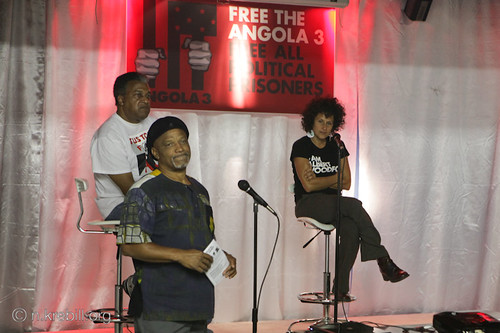


PHOTO: geronimo speaks at the recent A3 event in New Orleans.

In 2001, geronimo issued the following statement in support of the Angola 3:

Robert King Wilkerson, Albert Woodfox, and Herman "Hooks" Wallace are very dear to me because they come from my home state of Louisiana. The Louisiana chapter of the Black Panther Party was one of the best chapters we organized and they were some of our best, most disciplined soldiers. They were the kind of soldiers who never cried out to anyone for help, even though they were facing life imprisonment.

Understand that after being in that kinda situation for so long, I can personally attest to the highly disciplined and dedicated nature of these askaris. They endured, and they survived, over all the years, with very little help from the outside world. They are the kind of unsung heroes who we must come forward to help, because they never asked for anything from us in exchange for suffering what they have suffered.

To Struggle for the People and not expect anything selfish in return is a rare thing and this is what King, Wallace, and Fox have personified throughout all those hard years. They most certainly deserve our strongest salute.

There will be a memorial service at 10AM on June 18 at the Morgan City Auditorium in Morgan City, Louisiana, geronimo's hometown. For more info call Jones Funeral Home at: (985) 384-8643.

There will also be a memorial service for geronimo at the Eastside Arts Alliance in Oakland on July 15th at 6pm. This is a celebration of the life of a Revolutionary. East Side Arts Alliance is located at 2277 International Blvd. For more info call Billy X at (916) 455-0908.

http://www.indybay.org/uploads/2011/06/07/640_geronimo_cleevr.jpg

Geronimo Ji Jaga from Freedom Archives on Vimeo.